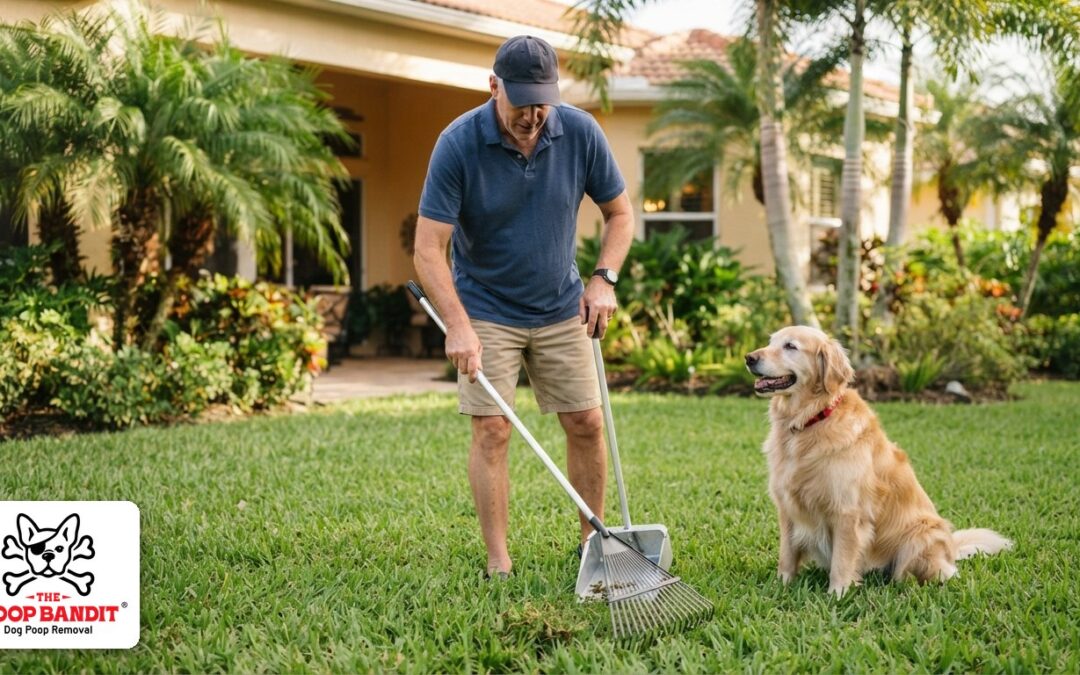
For most yards, the best dog poop scooper is a long-handled rake and pan for grass and a flat spade for gravel and patios (mulch too). A jaw-style scooper is the easiest on your back if you have 1 or 2 dogs. On thick St. Augustine grass, pick a pan with a flat spade edge instead of a toothed rake, because rake tines catch the runners and smear waste down into the turf.
That’s the short version.
The longer one depends on your ground and your dog count. Most adult dogs go at least 1 or 2 times a day, so a 2-dog home can easily pile up 15 to 20 messes a week, and a scooper that works great on a short Michigan bluegrass lawn can be miserable on a spongy Florida yard after an afternoon storm.
Our techs scoop yards in Central Florida and Macomb County every week, so we see what each style of tool does on different kinds of ground. Here’s what each one is good at, where it fails and when doing it yourself stops making sense.
The Main Types of Dog Poop Scoopers
Walk into any pet store and you’ll find a whole wall of scoopers, but almost all of them fall into 5 groups. Handle length and the way the tool picks up waste matter far more than the brand.
| Type | How it works | Best surface | Main downside |
|---|---|---|---|
| Rake and pan | You pull waste into a tall pan with a small rake | Short or medium grass | Tines snag thick grass and need rinsing often |
| Spade and pan | A flat blade slides under waste and pushes it into the pan | Gravel, pavers, mulch, dense turf | Harder to use on soft or soggy waste |
| Jaw or claw scooper | You squeeze a handle and two jaws close around the pile | Most grass, light mulch | Small capacity, so you empty it constantly |
| Hand-held or bag-attached | A short tool or frame holds a bag open, you grab and tie | Walks, small patios | You’re bending over every time |
| Long-handled scoop | A single scoop or shovel on a long pole | Large yards, heavy loads | Heavier, and it can dig up turf |
Most people end up owning 2 of these, and that isn’t wasteful at all, because 1 tool rarely handles both a soft lawn and a rocky side yard well.
Rake and Pan Sets
This is the classic setup, and for good reason, since the rake and pan combo lets you pull several piles into 1 container before you dump it, which is a lot faster than bending down and handling each pile separately. The tall back wall of the pan keeps waste from rolling out when you tip it.
The trouble starts with the rake. Metal tines grab grass runners and fallen leaves. After a few weeks they also hold onto old waste in the gaps between the teeth, and that’s where most of the smell comes from.
Spade and Pan Sets
A spade scooper swaps the rake for a flat blade. You hold the pan flat on the ground and push waste in with the blade. It’s the cleanest option on hard ground, and it’s our pick for pavers and pool decks, plus gravel runs and mulch beds.
On grass it works better than people expect, as long as the waste is firm. Soft piles just slide under the blade and spread.
Jaw and Claw Scoopers
Jaw scoopers have a trigger or squeeze grip on top and a pair of jaws at the bottom. You set the jaws around the pile, squeeze and lift. Some open wide enough to grab 2 or 3 piles before you empty them. They’re popular with older owners and anyone with a bad back, because you never bend down.
The catch is capacity and cleaning. The hinge area traps waste, and cheap springs wear out. Look for one with a simple pivot you can rinse with a hose.
Hand-Held and Bag-Attached Scoopers
These small tools clip a bag to a frame or let you grab through it with a short handle. They’re great on walks. For a whole backyard? Honestly, skip them. You’ll be bending over for every pile, and your knees will complain by Friday.
Long-Handled Scoops and Shovels
A plain long-handled scoop is basically a light shovel with a deeper head. It’s handy after a few missed weeks or with several large dogs, but it takes some turf with it every time, so keep it off a nice lawn.
Which Scooper Works Best on Each Surface
The ground under your dog decides more than anything else. A tool that glides on gravel can be useless on deep grass. Here’s how the common surfaces compare.
| Surface | Best tool | What to avoid | Tip |
|---|---|---|---|
| Short grass (Bermuda, bluegrass, fescue) | Rake and pan or jaw scooper | Heavy shovels that lift turf | Scoop when dry, not right after watering |
| St. Augustine grass | Spade and pan, or wide jaws | Fine-tooth rakes | Lift, don’t drag, so the runners stay clean |
| Gravel and river rock | Spade and pan | Rakes, they pull rocks into the pan | Tip the pan slowly so stones fall out first |
| Mulch and pine straw | Spade or jaw scooper | Deep shovels that remove mulch | Rake fresh mulch back over the spot |
| Pavers, concrete, turf pads | Spade and pan | Anything that smears | Rinse the spot after scooping |
| Sand or bare dirt | Long-handled scoop or slotted spade | Flat pans that fill with sand | Shake the scoop so sand drains out |
Florida St. Augustine Lawns
St. Augustine grass covers a huge share of Central Florida yards, and it’s the hardest common lawn to scoop. It has wide coarse blades, and it spreads by thick runners that sit on top of the soil, so the lawn feels like a springy mat. Anybody who has pushed a rake through it knows exactly what that feels like.
Waste doesn’t sit on top of that mat. It sinks into it. When you drag a rake across, the tines catch the runners, the pile breaks apart and pieces end up deeper in the grass, where they’ll keep smelling for days. A flat spade or a wide jaw lets you lift the pile straight up instead. Slide the blade under at a shallow angle, push it into the pan and lift.
Timing matters too.
Our summer afternoons bring rain most days, and wet St. Augustine turns firm waste into a mess within 1 hour. If you can, scoop in the morning before the storms.
Gravel, Mulch and Hardscape
Gravel dog runs are popular because they drain well, but they’re tricky to scoop. A rake pulls up half the rocks along with the waste. A spade lets you skim just the top layer, and if a few stones go into the pan, tip it slowly so they slide out first.
Mulch and pine straw are similar. You’ll always take a little mulch with each pile, which is fine. Just top it up 1 or 2 times a year. On pavers and pool decks, scoop with a spade and then hose the spot, because a thin film always stays behind and it’s slippery once it dries in the sun.
How to Scoop Cleanly Without Making a Mess
The tool is only half the job. How you use it decides if your yard actually ends up clean or just looks clean from the patio.
- Walk the yard in a grid: go back and forth in lanes, like mowing. Wandering around looking for piles is how you miss the ones behind the AC unit.
- Scoop firm waste, not fresh: a fresh pile smears. If it just happened, wait a few hours.
- Keep the pan low: set it on the ground right next to the pile so nothing falls on the way in.
- Line the pan with a bag: some pans take a bag liner. It means you never have to scrape the pan out.
- Check the shady spots and fence lines: dogs like corners, and so do flies.
One habit that helps a lot: do the same route every time. You’ll remember where your dog likes to go, and you’ll stop missing those spots after 1 or 2 weeks.
Where the Waste Should Go After You Scoop
Disposal is where a lot of people quietly get it wrong. A full pan has to go somewhere, and some of the obvious places cause more trouble than they solve.
For most homeowners the trash is the right answer. Double bag it or tie the bag tight, and put it in a lidded outdoor bin, not the kitchen can. In Florida heat, an open bag in a garage turns into a fly problem within 24 hours.
What to avoid:
- The storm drain or the ditch: this one matters. The EPA lists “bacteria and nutrients from pet waste” among the pollutants that wash off urban areas into lakes and rivers.
- The yard waste bin: many haulers don’t accept pet waste with yard clippings. Check your city or county rules.
- Your vegetable garden compost: dog waste can carry parasites that a backyard compost pile won’t reliably kill, so keep it away from anything you eat.
- A pile behind the shed: it never “breaks down” as fast as people hope, and it rains straight into the soil and groundwater.
That runoff point isn’t just theory here. Stormwater carries nitrogen and phosphorus from fertilizers and pet waste into waterways, as the EPA explains on its stormwater pollution page, and those nutrients feed the algae that turn Central Florida ponds green. If you live near a retention pond or a lake, scooping and bagging is the simplest thing you can do for it.
How to Clean and Sanitize Your Scooper
Nobody likes this part. Skip it, though, and a tool with dried waste in the tines will smell worse than the yard itself after a hot week.
Here’s a simple routine that works:
- Rinse the pan and rake or spade with a hose after every use. Do it over a spot in the yard, not a drain or a driveway that runs to the street.
- Once a week, scrub with hot soapy water and a stiff brush, paying attention to the tines and hinges, plus the corners of the pan.
- Then spray or soak with a disinfectant and leave it wet for the full time on the label.
- Let it dry in the sun with the pan tipped so water doesn’t pool.
That third step is the one people rush. A disinfectant only works if the surface stays wet for its contact time, which is printed on the label and can be several minutes. The EPA’s guide to registered disinfectants explains how to read that label and confirms the registration number is the only reliable way to identify a product. If you use diluted bleach, follow the bottle’s directions, and never mix it with ammonia or other cleaners.
Store the scooper outside and upright. A closed shed in August is the worst spot for it.
Wear rubber gloves for scooping and cleaning, since dog waste can carry bacteria and parasite eggs.
Common Mistakes With Poop Scoopers
These come up constantly, and almost all of them make the job take longer than it should.
- Buying a short tool to save money: you’ll bend for every pile and stop scooping as often.
- Using a rake on thick grass: it’s the most common mistake we see in Florida yards. Switch to a spade.
- Waiting too long between cleanups: 14 days of waste is a different job from 2 days. Old piles break apart, dry into the grass or get mowed and spread around the yard.
- Mowing before scooping: this one is just painful. The mower blade spreads waste over the lawn, and your lawn crew won’t thank you for it.
- Scooping only what you can see from the patio: the far corners and the side yard get forgotten, and those are often the worst spots.
Most of these fix themselves once scooping happens on a set day.
What a Scooper Costs You in Money and Time
A decent rake and pan or jaw scooper is one of the cheaper pet purchases you’ll make, and the tool itself is rarely the real cost. Bags and disinfectant add up slowly over 12 months, and so does the replacement you’ll buy when a spring breaks.
The bigger cost is time. Think about what a typical week actually involves:
- finding the scooper and the bags,
- walking the whole yard in lanes,
- bagging and carrying waste to the bin,
- rinsing and storing the tool,
- and a deeper clean once a week.
For 1 small dog in a small yard, that might be 10 minutes.
With 2 or 3 big dogs on a half-acre lot in Horizon West it’s often 30 minutes or longer once you count bagging and rinsing, and when you add the Florida heat and the mosquitoes on top of the afternoon rain, it’s easy to see why so many people quietly stop doing it by July.
DIY isn’t wrong, and plenty of owners scoop their own yards every week and do a great job of it, but it helps to be honest with yourself about how much time it really takes. We compared the two options side by side in DIY vs professional dog waste removal.
A Realistic Example From a West Orlando Yard
Picture a family in a newer neighborhood near Winter Garden. Two medium dogs, a fenced backyard of St. Augustine grass, a gravel strip along the side of the house and a mulch bed by the patio. It’s a composite, but our techs see this setup every week.
They started with a basic rake and pan. On the lawn, the tines kept snagging and the piles broke apart, so pieces stayed in the grass. The gravel strip was worse, since every scoop came back half full of rock. After a rainy week the yard smelled. The kids stopped playing out back. Sound familiar?
They switched to a spade and pan for the lawn and gravel, and kept a jaw scooper by the back door for quick daily grabs. That fixed most of it, and for about a month the yard looked better than it had all year, with no snagged runners and no gravel in the pan. The part that still didn’t work was time. Both parents worked, summer storms ate their evenings, and some weeks it just didn’t happen. That’s usually the point where people start looking at a service.
When Hiring a Pooper Scooper Service Makes More Sense
A good scooper and a steady routine will handle a lot of yards. Sometimes, though, hiring someone is simply the better deal.
- You have 3 or more dogs: the volume grows fast, and so does the time.
- Your schedule is unpredictable: if scooping gets skipped every other week, the yard never really gets clean.
- Physical limits: bad backs, knees, pregnancy or just getting older. A jaw scooper helps, but it doesn’t make the job go away.
- The yard got away from you: a big one-time cleanup resets everything, and a one-time dog poop removal visit is often how people start.
- You want the smell gone, not just the piles: waste leaves bacteria and odor in the soil. A deodorizing and sanitizing treatment handles what a scooper can’t.
The math is usually simpler than people think. A weekly dog poop removal visit takes the job off your list, and the price depends mostly on how many dogs you have and how big the yard is. If you want real ranges before you call anyone, our guide to pooper scooper service cost lays them out.
Let Poop Bandit Handle the Scooping
If you’d rather keep your scooper for the odd mess on a walk and leave the yard to someone else, we can help. Poop Bandit offers weekly and twice-weekly dog poop removal, one-time cleanups and yard deodorizing and sanitizing, including WysiWash treatments. We serve Winter Garden, West Orlando, Clermont, Apopka, Ocoee, Windermere, Dr. Phillips, Horizon West and Orlando, plus Macomb County in Michigan.
We have more than 150 five-star Google reviews, and there are no long-term contracts. Call (407) 604-1008 for a free quote, and tell us how many dogs you have and what your yard looks like.
FAQ
These are the questions we hear most from dog owners shopping for a scooper or trying to make the one they have work better.
What Is the Best Dog Poop Scooper for Grass?
For short grass, a rake and pan or a jaw scooper works well. For thick lawns such as St. Augustine, a spade and pan or a wide jaw scooper is better, because rake tines catch the runners and spread waste into the turf.
How Do You Pick Up Dog Poop From Gravel?
Use a flat spade and pan. Slide the blade under the pile, skimming just the top layer of rock, and tip the pan slowly so stones fall out before the waste. Rakes pull up too much gravel to be practical.
How Often Should You Clean a Poop Scooper?
Rinse it after every use and give it a full scrub and disinfecting once a week. Leave the disinfectant wet for the contact time on the label, then let the tool dry in the sun before storing it.
Can You Put Dog Poop in the Yard Waste Bin?
Usually not. Many haulers don’t accept pet waste with yard clippings, so check your city or county rules. For most homes, a tied bag in a lidded trash bin is the safest choice. Never put it in a storm drain.
Is It Cheaper to Scoop Yourself or Hire a Service?
Scooping yourself costs less in money, since a tool and bags are cheap. A service costs more but saves your time every week. For multi-dog homes or busy schedules, many owners find a weekly visit worth it.